Two vocabularies, one alphabet, one reading list Glossary and sources
Writing Civil War haiku means holding two technical vocabularies at once: the words a nineteenth century army used for its own equipment and ground, and the words a Japanese poetic tradition uses for its own machinery. Both are here, in one alphabet, because in practice you need them in the same sentence. The reading behind the whole collection follows the glossary.
36 entries Sixteen works A to Z Military terms are those in ordinary use between 1861 and 1865.
Looking for the books rather than the words? Jump to the reading list, or to the six kinds of record and what each one distorts.
All entries
A 2 entries
- Abatis
-
A field obstacle made of felled trees laid with their sharpened branches pointing toward the enemy. Cheap, quick, and effective at slowing an assault long enough for it to be shot at.
- Ambrotype
-
A photograph on glass, common in the late 1850s and early 1860s and usually kept in a small hinged case. The picture found on an unidentified Union sergeant at Gettysburg was one of these. the case in question
B 2 entries
- Bivouac
-
A camp made without tents, for one night, usually because the army is moving. A bivouac is a decision about tomorrow rather than an arrangement for tonight.
- Breastworks
-
A low field fortification about chest high, thrown up quickly from earth, logs, fence rails or loose stone. By the later years of the war soldiers entrenched almost automatically whenever they stopped.
C 3 entries
- Canister
-
An artillery round consisting of a tin can filled with iron or lead balls, which burst at the muzzle. At short range it turned a field gun into an enormous shotgun, and it is the reason assaults across open ground failed.
- Colours also colors
-
The regimental flags. They marked the position and direction of a regiment in smoke, which made the men carrying them the most reliably targeted soldiers on any field.
- Crape
-
A dull black crimped silk hung on a door or worn on a sleeve or bonnet as a sign of mourning. The period for which it was worn was fixed by custom rather than by feeling.
D 2 entries
- Dead line
-
A line marked inside a prison stockade, crossing which a prisoner could be shot without warning. At Camp Sumter in Georgia, generally known as Andersonville, it was a light rail fence set a short distance inside the wall.
- Desiccated vegetables soldiers' name: desecrated vegetables
-
Pressed cakes of dried mixed vegetables issued to prevent scurvy. Universally issued and universally detested.
E One entry
- Enfilade
-
Fire delivered along the length of a line rather than against its front. It is what finally emptied the sunken road at Antietam, and it is why a salient is a dangerous place to stand. the lane at Antietam
F One entry
- Forlorn hope
-
A party of volunteers sent first into an assault where losses were expected to be very heavy. The name is a corruption of a Dutch phrase meaning lost troop, and it is older than this war by centuries.
G One entry
- Graybacks
-
Soldiers' word for body lice, which nobody escaped. Occasionally, and confusingly, also used for Confederate soldiers.
H 5 entries
- Haibun
-
A passage of prose that closes on a haiku. Basho's travel journals are the model, and the combination suits a march, a hospital visit or a walk across preserved ground.
- Haiku
-
A very short poem, usually in three lines, that sets one concrete image beside another and leaves the relation between them unstated. the form in full
- Hardtack also hard bread, worm castles, sheet iron crackers
-
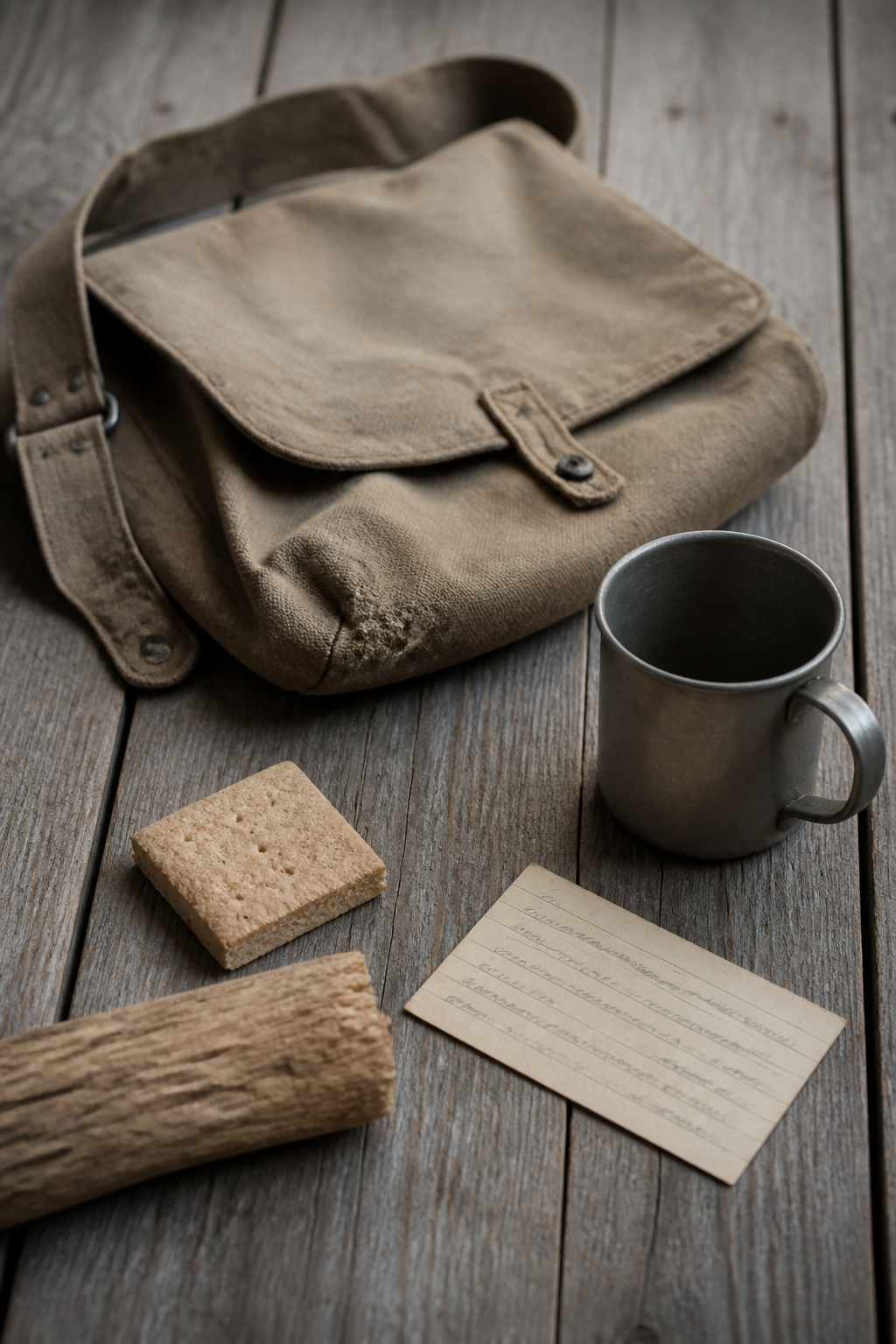
A biscuit of flour and water roughly three inches square, issued in place of bread. Hard enough to break teeth, and normally soaked in coffee before being eaten.
- Haversack
-
A canvas bag worn over one shoulder holding a soldier's rations. Everything a man expected to eat in the next three days was in it.
- Hokku
-
The opening verse of a linked chain of Japanese verse, and the direct ancestor of haiku. The standalone poem only came to be called haiku in general use during the 1890s.
K 2 entries
- Kigo season word
-
A word that fixes a haiku in a particular time of year and brings a set of associations with it. For Civil War subjects the season word doubles as evidence, because the war is unusually well dated.
- Kireji cutting word
-
In Japanese, a particle that breaks a haiku into two parts held against each other. English has no equivalent word and does the same job with a colon, a full stop or a line break.
L One entry
- Limber
-
A two wheeled cart carrying an ammunition chest, hitched in front of a field gun to move it. To limber up is to prepare to leave; to unlimber is to prepare to fire.
M One entry
- Muster
-
The formal assembly and roll call of a unit, and the written record it produced. Muster rolls are the principal reason we know who served, who was present, and who was not.
O One entry
- On sometimes called morae
-
The sound unit counted in Japanese verse. A haiku contains seventeen of them. They are shorter than English syllables, which is why a strict five, seven, five in English usually produces a padded poem.
P One entry
- Picket
-
A soldier or small party posted forward of a camp to give warning of an approach. Picket duty was constant, cold, and one of the commonest ways to be killed outside a battle.
R One entry
- Renga
-
A chain of linked verses composed by several poets in turn. Haiku descends from its opening verse, which is why the form still behaves as though something might follow it.
S 7 entries
- Salient
-
A part of a line that bulges toward the enemy, and can therefore be fired into from three directions at once. Holding one is usually a decision somebody regrets.
- Senryu
-
A poem shaped exactly like a haiku but aimed at human behaviour rather than at the natural world, and usually without a season word. Most good camp life poems are senryu.
- Shasei sketching from life
-
Masaoka Shiki's principle that a poem should record direct observation rather than literary convention. It is the reason modern haiku looks the way it does.
- Shebang
-
A rough shelter thrown together from whatever came to hand: brush, rails, a tent half, a blanket. The word outlived the thing.
- Skirmish line
-
A thin line of men spread several paces apart and sent ahead of the main body to find the enemy. Skirmishers fought as individuals, which was unusual for the period.
- Sunken road
-
A farm lane worn below the level of the fields on either side by years of cart traffic. Two of them, at Antietam and at Fredericksburg, shaped battles because they worked as ready made trenches. the lane behind the stone wall
- Sutler
-
A licensed civilian merchant who followed an army selling food, tobacco, paper and small goods at prices complained about in essentially every surviving soldier's letter.
T 2 entries
- Tanka
-
A Japanese poem in five lines of five, seven, five, seven and seven sound units. Older than haiku and permitted to state a feeling outright, which makes it the right form for a letter or an absence. tanka, with an example
- Tattoo
-
The evening drum or bugle call ordering soldiers to their quarters, sounded before the final call of the day. Nothing to do with ink.
V One entry
- Vedette
-
A mounted sentry posted forward of a picket line. Cavalry did most of the seeing in this war, and the vedette was the eye at the end of it.
W One entry
- Worm fence also snake fence, Virginia rail fence
-
A rail fence built in a zigzag without posts. It was the commonest field boundary across the theatre of war, the commonest cover on a battlefield, and the commonest firewood in a camp.
Z One entry
- Zouave
-
A regiment dressed in a uniform copied from French colonial troops in North Africa, with baggy trousers, gaiters and a short jacket. Several served on both sides, and they were as conspicuous as they sound.
Sources and further reading

Nothing on this site is asked to be taken on trust. What follows is the reading behind it: the six kinds of record a poet can work from, what each one quietly gets wrong, and the sixteen works the facts on these pages come out of.
Six kinds of record, and what each one distorts
Read this before the book list
| Kind of record | What it gives | What to watch |
|---|---|---|
| Letters and diaries | Weather, food, mood, the ordinary hour, the exact word for a thing | Written for a family: illness and fear are often left out on purpose |
| Memoirs | Shape, anecdote, remembered dialogue | Written decades later, and shaped by what the author wanted remembered |
| Official reports | Times, distances, ground, formations, numbers | Written to explain a decision, sometimes to defend one |
| Regimental histories | Names, movements, local detail found nowhere else | Produced by and for veterans' associations, and generous to their own |
| Photographs | Objects, clothing, terrain, the shape of a fence | Long exposures ruled out action, and bodies were sometimes moved for a picture |
| Newspapers | What the home front was told, and when | Casualty lists were frequently wrong, and corrections came late |
Wide table: scroll sideways to read it all.
in the archive
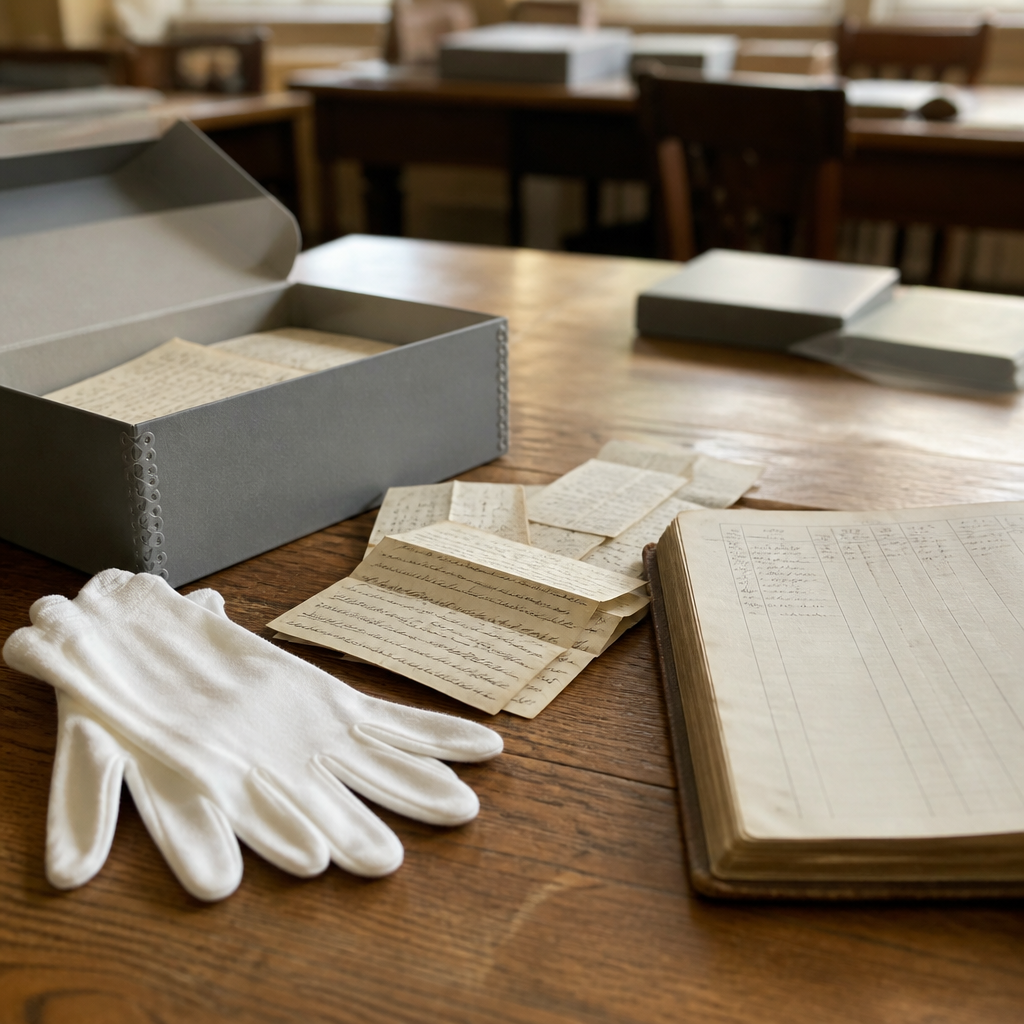
Written for this collection. Ground: manuscript collections hold letters that were kept in pockets and knapsacks for months before they were posted.
a letter still folded
the way it was carried
The reading list
The war itself Three works
- Battle Cry of Freedom James M. McPherson, 1988
-
The standard single volume history. If you read one book before writing about this war, read this one. It gives you the sequence, which is what stops a poem being set in the wrong year.
- The Civil War: A Narrative Shelby Foote, three volumes, 1958 to 1974
-
A narrative written by a novelist, and it reads like one. Superb for the texture of a day. Thin on citation, so check anything you intend to build a poem on.
- The War of the Rebellion The Official Records, 128 volumes, 1880 to 1901
-
The compiled official records of both armies: orders, reports, correspondence, returns. Not readable in the ordinary sense, and indispensable. This is where a sentence like the one about the corn at Antietam comes from. that sentence, in its place
The soldier Four works
- Hardtack and Coffee John D. Billings, 1887
-
Written by a veteran of a Massachusetts battery about the ration, the tent, the louse and the pay day. The single most useful book on this list for anyone writing short poems, because it is made entirely of objects.
- Co. Aytch Sam R. Watkins, 1882
-
A Tennessee private's memoir of the western armies, funny and bleak in the same paragraph. A memoir, with all that implies, but the voice is unmistakable.
- The Life of Johnny Reb Bell Irvin Wiley, 1943
-
Built out of thousands of soldiers' letters. Old scholarship in places, still the foundation for what we know about how Confederate soldiers lived.
- The Life of Billy Yank Bell Irvin Wiley, 1952
-
The companion volume, on the Union soldier. Read alongside Billings for the difference between a historian's account and a participant's. the poems these produced
Death and mourning Two works
- This Republic of Suffering Drew Gilpin Faust, 2008
-
How the country handled death on a scale it had no machinery for: the condolence letter, identification, embalming, burial, the national cemeteries. The book behind most of the page on war and loss.
- A Census-Based Count of the Civil War Dead J. David Hacker, in Civil War History, 2011
-
The article that revised the death toll upward from about 620,000 to roughly 750,000 by working from census data rather than army records. Both figures are still in circulation, which is why this site quotes both.
Poets of the war Four works
- Drum-Taps Walt Whitman, 1865
-
Written by a man who spent much of the war in the Washington hospitals. The short pieces are the ones to study: a cavalry column fording a river, a bivouac on a hillside, three covered forms at daybreak.
- Specimen Days Walt Whitman, 1882
-
Prose notes from the same years, and the source of the remark that the real war will never get in the books. Worth reading immediately after any ambitious plan for a war poem.
- Battle-Pieces and Aspects of the War Herman Melville, 1866
-
Written by a man who did not fight, largely from newspapers, and honest about it. The shorter pieces are compressed almost to the point of being epitaphs.
- The poems of Emily Dickinson, 1861 to 1865 Written during the war, published later
-
She almost never names the war and 1862 was the most productive year of her life. A standing argument for what a poem can carry without stating its subject.
The haiku tradition Three works
- Oku no Hosomichi Matsuo Basho, journey of 1689, published 1702
-
The travel journal containing the Hiraizumi poem, which is the oldest famous battlefield haiku and the model for everything attempted here. the poem, and what it does
- An Introduction to Haiku Harold G. Henderson, 1958
-
Still the clearest short account in English of what the form is doing, with the originals alongside the translations so you can see the count for yourself.
- The Haiku Anthology Edited by Cor van den Heuvel, third edition 1999
-
English language haiku as it is actually written, which is mostly not in five, seven, five. The best single argument for the short, long, short shape used on this site.
Where the paper is
Named, not linked
Manuscript material for this war is held in a very large number of places, and the useful starting points are the same for everyone: the Library of Congress, the National Archives and Records Administration, the National Park Service units that administer the battlefields at Gettysburg, Antietam and Fredericksburg, and the manuscript collections of state historical societies and university libraries.
This site links to none of them on purpose. Institutional addresses move, and a reading list that has to be maintained is a reading list that will eventually be wrong. The names above are stable and will find the collections from any search box.
- The form, where kigo and kireji do their work
- Hardtack, sutler and shelter half in use
- Tanka, senryu and the cinquain compared
- The poems all of this produced
- Tracing one soldier through state records
- How is a Baptist worship service structured from opening hymn to benediction?
- Which buckwheat should a small dry garden start with?
- What counter-ads answered the pro-Palestinian subway posters in 2011?
- Why does a Civil War reader care about a French coin treaty?
- How do you handle family who expect a traditional role?
- How should an old devotional object be observed, stored, bought and handed on?