A sequence, twelve prompts, six worked examples Civil war poetry examples for students
Haiku is the cheapest assessment instrument in a history classroom. It takes fifteen minutes, it cannot be padded, and it exposes immediately whether a student has a picture of the past in their head or only a set of words about it. This page is the sequence, the prompts and the marking criteria, written for teachers who have one lesson rather than a unit.
Five steps Twelve prompts Six examples Sixty five minutes, or two shorter lessons.
The task in one sentence: find one checkable fact about the American Civil War, turn it into something you could photograph, and cut it to three lines that explain nothing.
1. Why this works
- It cannot be faked. A student who has not looked at a source cannot produce a concrete image, and the absence shows in three lines.
- It removes the word count as a hiding place. Nobody can write around a subject in twelve syllables.
- It rewards research directly. The best poems in a class are always the ones written by the student who found the oddest true detail.
- It is fast to mark. Four criteria, one glance each. The rubric is in section five.
One preliminary. Tell the class at the start that five, seven, five is a translation of a Japanese count into an English unit that does not match it, so the class will be writing short, long, short instead. This converts the rule they resent into a fact they find interesting, and it takes ninety seconds. the full explanation of the count
2. The five step sequence
- Read three, say nothing. Ten minutes. Read three poems aloud, twice each. No discussion, no analysis, no hands up. The silence is doing the work.
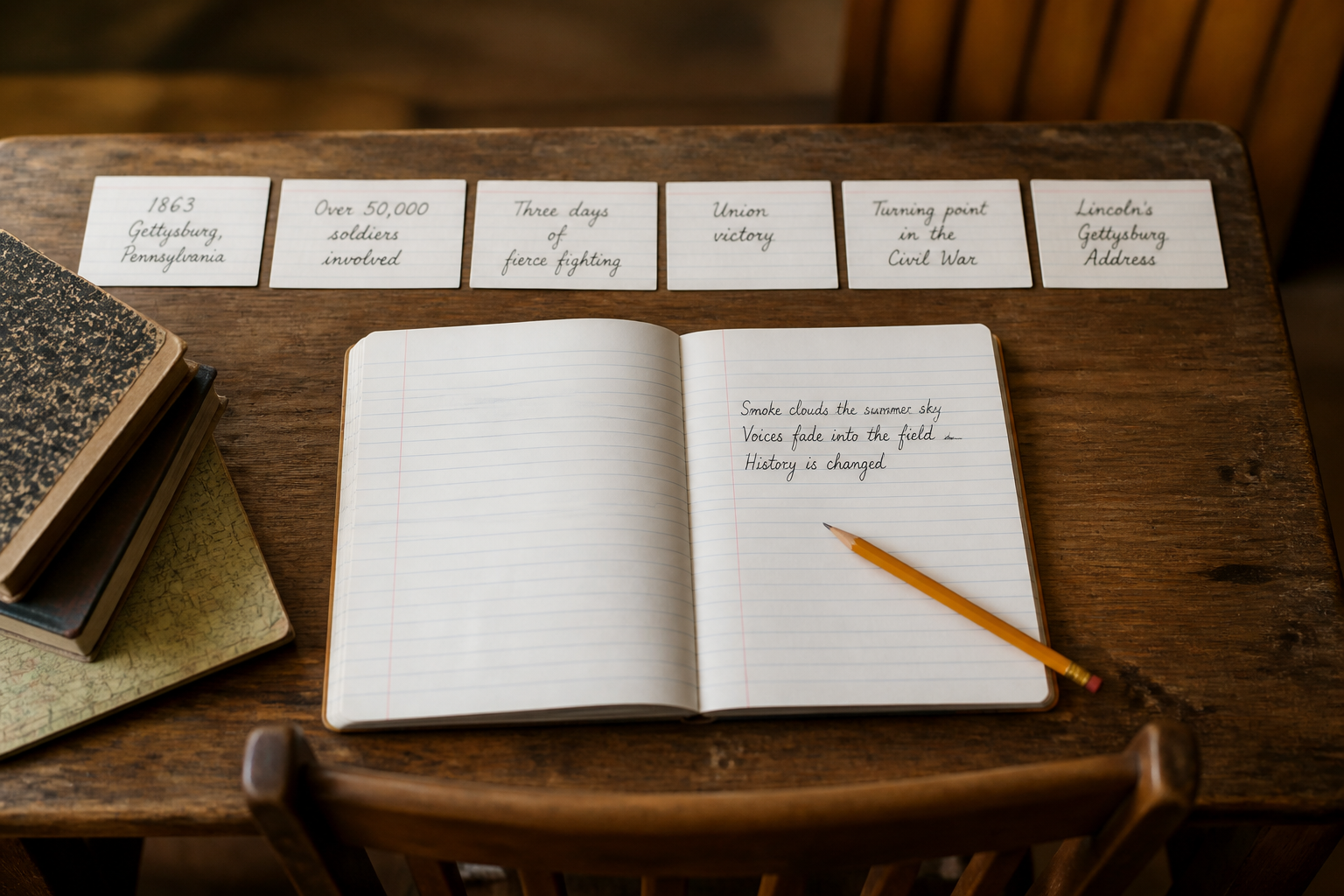
- Fetch one fact. Fifteen minutes. Every student finds one checkable detail from the source set and writes it on a card: a date, a ration, a weather report, a place name, a price, a distance.
- Make it visible. Ten minutes. Turn the fact into one sentence containing only things a camera could have recorded. No feelings, no opinions, no words ending in ness.
- Cut it to three lines. Fifteen minutes. Short, long, short. Remove every adjective, then allow one back if the poem genuinely needs it. Find the place where the poem breaks in two.
- Read aloud and name the cut. Fifteen minutes. Each student reads their poem and then says one sentence: where it breaks, and what the two halves do to each other.
If you only have twenty minutes
- Hand out the facts yourself, one per student, from the prompt list below.
- Skip step three and go straight from the fact to three lines.
- Keep step five. It is the part that teaches.
3. Twelve prompts, each tied to a fact
Each prompt below is anchored to something documented. Students who want to check any of them will find the underlying detail elsewhere on this site.
- Coffee being made before dawn in a winter camp in Virginia, January 1863.
- Ripe wheat standing at Gettysburg on the morning of 01/07/1863.
- Two soldiers sharing a shelter tent, each of them carrying half of it.
- Hard bread soaked in coffee until it can be eaten.
- A wooden grave marker with a name written on it in pencil.
- The aurora borealis over the field at Fredericksburg, night of 14/12/1862.
- Mail call, and one man who does not get a letter.
- Full grown corn standing in a Maryland field before sunrise on 17/09/1862.
- A pay table, and two different rates of pay, before June 1864.
- A country church with its pews carried outside so that it can be used as a hospital.
- A photograph of three children, found on a battlefield in July 1863.
- Flowers laid on a grave marked unknown, 30/05/1868.
4. Six worked examples
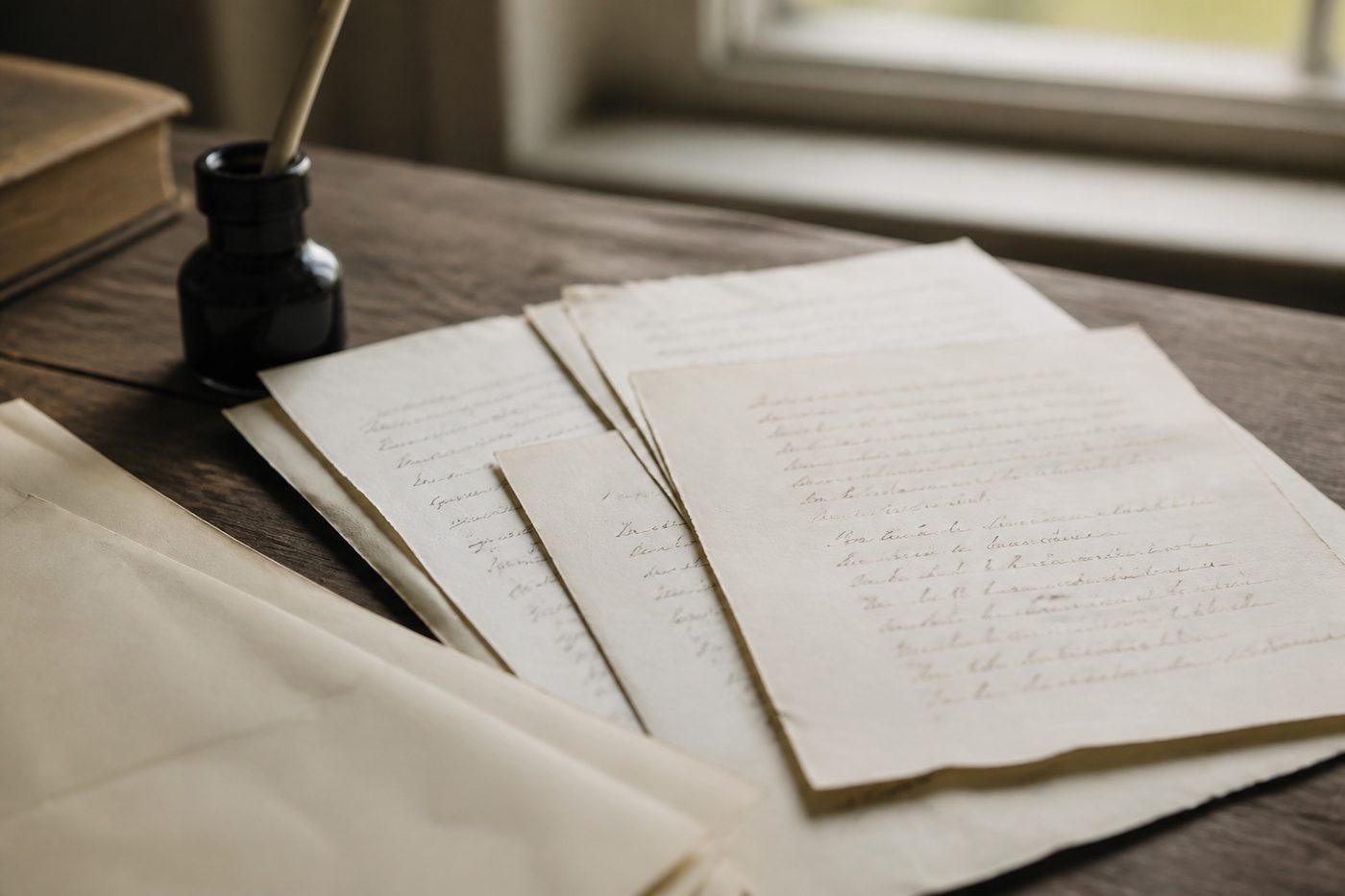
These are written at the level a class can reach in one lesson, not at the level of a published poem. That is deliberate. Showing students a professional example at this point usually stops them writing.
coffee before light
Written for this collection. Ground: student level. Fact used: coffee was the first thing made in a camp, before dawn.
the whole camp awake
at the same time
July wheat
Written for this collection. Ground: student level. Fact used: the wheat around Gettysburg was ripe and standing in the first days of July 1863.
the fence and the road
both full of dust
rain on the tent
Written for this collection. Ground: student level. Fact used: each soldier carried one half of a two man shelter tent.
half of it is mine
half is his
hard bread in the cup
Written for this collection. Ground: student level. Fact used: hardtack had to be soaked in coffee before it could be eaten.
waiting for it
to be food
pencil on a board
Written for this collection. Ground: student level. Fact used: battlefield graves were marked with wooden headboards that weathered away.
four winters
and then nothing
red light in December
Written for this collection. Ground: student level. Fact used: the aurora seen over Fredericksburg on the night of 14/12/1862.
everybody stops
to look up
5. What to mark
| Criterion | Not yet | Getting there | There |
|---|---|---|---|
| Concrete image | Names a feeling or an idea | One picture, blurred by adjectives | One picture a camera could have taken |
| Historical anchor | Could be any war, any century | A real detail, loosely placed | Tied to a named place, month, ration or hour |
| The cut | One sentence in three pieces | It breaks, but both halves say the same thing | Two parts that change each other |
| Restraint | Tells the reader what to feel | Explains a little at the end | Stops the moment the image is complete |
Wide table: scroll sideways to read it all.
6. Four ways it goes wrong
- The abstraction. Sorrow, freedom, sacrifice, bravery. These words are the sound a poem makes when there is no picture in it. Ask: what would a camera have seen?
- The adjective pile. Cold bitter frozen lonely field. One adjective is a decision; four is an apology.
- The moral at the end. A third line that explains the first two. Cover the last line and ask whether the poem is better without it. It usually is.
- The anachronism. Snow in July, an image from a later war, a word not yet in use. This is the one worth being strict about, because the fix sends the student back to the source.
7. By age group
- Younger classes. Start with the American cinquain rather than haiku: it counts English syllables, so there is no translation problem to argue about. Keep the material to camp, food, weather, animals, music and letters. the cinquain, with an example
- Middle years. Haiku, one sourced fact per student, and the cut introduced explicitly. Battles handled at the level of ground and weather rather than casualties.
- Older classes. Senryu and found poems, worked from primary sources, plus the question the form raises on its own: who is entitled to write about whose suffering, and what changes when the poet has a fact and when they do not.
On handling the violence
- The form is unusually safe here, because a haiku cannot dwell. It shows one thing and stops.
- Almost everything worth writing about this war happened outside the fighting: the ration, the letter, the illness, the pay table, the grave marker.
- If a class needs a limit, set it at the edge of the field. There is more than enough material there.
- The form, for the ninety second explanation
- Twenty poems to read aloud in step one
- Terms students will meet in the sources
- Where to send students to fetch a fact
- Where a fetched fact can come from
- Where did the Be On Our Side campaign begin?
- Who started El día de los niños / El día de los libros and how did it spread since 1997?
- How do you revise a children's manuscript?
- When is high school track and field season, and what should students expect at practices and meets?